


Cross Hatch Adhesion Test - The most Reliable Method for Estimating Coating Adhesion ISO 2409, ASTM D 3359
How do Cross-Cut / Cross Hatch Adhesion Testers work for cross-cut testing according to DIN EN ISO 2409, ASTM D 3359 & DAIMLER DBL 5416 /7384?


Introduction
Cross Hatch Adhesion testing is a proven technique for estimating the adhesion of coatings, including painted surfaces. This method, which is carried out in accordance with DIN EN ISO 2409, is explicitly not used to measure the adhesive strength, but rather to estimate it. For an exact measurement, the deduction test according to DIN EN ISO 4624 should be used.
Proceedings
A cross cut involves making six parallel cuts and another six perpendicular scribe cuts on the coating to create a regular square pattern. The cuts must go through to the ground without damaging it too much. The test can be carried out manually or with a motor-driven device.
Coating thickness and grid spacing
The thickness of the coating and the grid spacing affect the process of cross-cutting. For coating thicknesses of up to 60 micrometers, a grid spacing of 1 millimeter (on a hard substrate such as metal) or 2 millimeters (on a soft substrate such as wood) should be selected.
A grid spacing of 2 millimeters is required for coating thicknesses between 61 and 120 micrometers and a grid spacing of 3 millimeters is used for coating thicknesses of 121 to 250 micrometers. Above 250 micrometers the cross cut is no longer applicable, in this case a cross cut test according to DIN EN ISO 16276-2 should be carried out.
Removal of particles
After completing the crosscut, it is important to remove any loose debris from the cuts. A soft brush, compressed air, nitrogen or adhesive tape can be used for this. Since 2013, the adhesive strength of the adhesive tape is no longer specified, but it should be applied parallel to one direction of the cuts and then removed quickly (0.5-1 seconds) at an angle of 60° within 5 minutes.
Evaluation of the grid
At the end of the crosscut, the remaining grid is examined. A distinction is made here between cross-cut characteristic values from 0 (very good) to 5 (very bad), abbreviated Gt 0 to Gt 5. In addition to this classification procedure, a yes/no test can also be carried out for the respective specifications. Characteristic values of Gt 0 or Gt 1 are often accepted in the field of corrosion protection.
ASTM D3359 method B Test Procedure:
Note: Instructions provide brief summaries of procedures used to perform the cross hatch adhesion test. Consult and follow the ASTM D3359 (method B) test method prior to testing
Preparation
The test specimens should be prepared as detailed in the standard. ASTM D3359 recommends several best practices for proper surface preparation (ASTM D609, D1730, D2092, and D823).
For hard panels, the minimum thickness is 0.25 mm (0.01”). For relatively soft panels such as wood, the minimum thickness is 10 mm (0.4”).
Conduct the test at room temperature unless otherwise agreed.
The test area should be flat and free of blemishes and other surface imperfections.
To determine the correct cutting blade, measure the sample’s dry film thickness using a coating thickness gage such as the PosiTector 6000, PosiTector 200, or PosiTest DFT.
Procedure
Step 1: Verify the cutting tool has the blade matched to the coating's dry film thickness (DFT). Use the 1 mm blade with 11 teeth for coats 0–50 µm (0–2 mils). Use the 2 mm blade with 6 teeth for coats 50–125 µm (2–5 mils).
Step 2: Check the cutting blade before every use for wear or damage. If the edge is nicked or dull, swap to a fresh blade. See the instruction manual for details.
Step 3: Put the test panel on a solid, flat surface. Set the tool on the coated area with the blade perpendicular to the coating, then pull it across to make a mark about 20 mm (¾ in) long. After cutting, gently brush the surface with the included brush to lift off any loose coating flakes.
Step 4: Repeat Step 3, making a second set of cuts at 90° to the first and centered on them, forming a lattice grid. Brush lightly again to clear debris.
Note: Every cut must bite into the substrate; if not, the test is invalid and should be redone in a new spot. Use the supplied illuminated magnifier to confirm light reflects off the metal substrate.
Step 5: Take a piece of pressure-sensitive tape about 75 mm (3 in) long from the roll.
Note: At the start of each workday, peel off and discard two full turns of tape from the roll.
Step 6: Center the tape over the lattice, press it down with a finger, then firmly rub the surface with a pressure applicator or a suitable alternative (e.g., rubber eraser or rubber roller) until the tape looks uniformly colored.
Note: Uniform color means the tape is in solid contact with the test surface.
Step 7: Pull the tape off by holding the free end and snapping it back over itself at an angle as close to 0° as possible. Finish the test within 1–2 minutes after cutting the lattice.
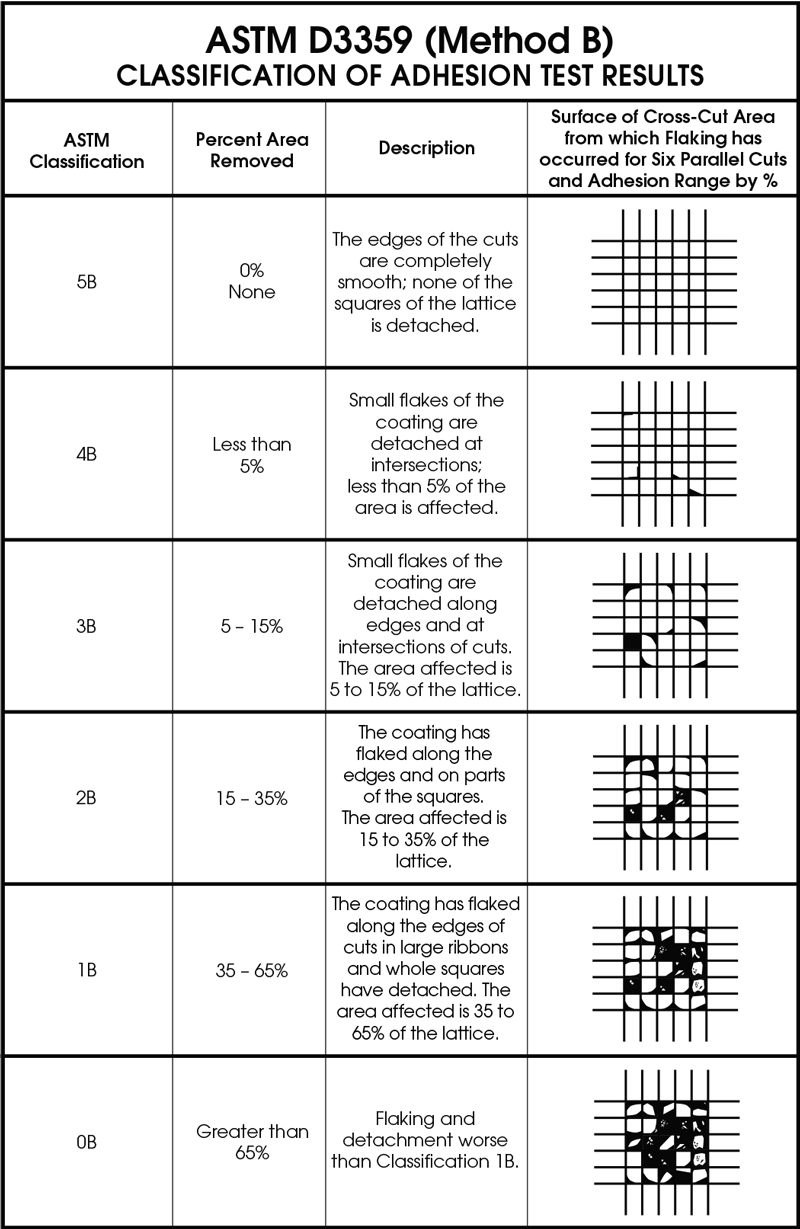
Step 8: Inspect the cut area visually (with or without the included 10× magnifier) and grade the result using the descriptions and images in the ASTM D3359 Adhesion Test Classification Chart.
ASTM D3359 Classification of Adhesion Test Results

Cross Hatch Adhesion Testers like the CC 1000, CC 3000 and CC 5000...
evaluate a coating's adhesion strength by testing its resistance to separation from the substrate using a lattice pattern, fully compliant with ISO 2409 and ASTM D3359 standards.
• mtv messtechnik offers complete kits with all necessary tools and accessories for accurate cross hatch adhesion testing
• Ergonomic handle with a non-slip grip ensures comfortable use, even during extended testing sessions
• Pivoting cutting head maintains optimal positioning and consistent pressure across the surface
• Durable, high-grade hardened steel blade for extended testing life
• Select adhesive tapes tailored to ISO 2409 specifications for reliable results
Business hours:
Monday - Thursday from 8:30 a.m. to 5 p.m. and Friday until 3 p.m

Justus-von-Liebig-Strasse 17a
50374 Erftstadt (Gymnich)
49 2235 987170 info@mtv-messtechnik.de